




Legal research often begins with a specific question. To find relevant documents, users need a search engine designed for legal information and tools to refine their results. The organizations that publish these documents therefore play an essential role in making them accessible.
The Real Estate Council of Ontario (RECO) has chosen Norma, our all-in-one legal publishing platform, to make its decisions easier to search and consult. Launched on November 10, 2026, its new site provides access to decisions from 2018 onwards, along with a selection of earlier decisions.
RECO’s role
RECO regulates real estate agents and brokerages in Ontario to protect consumers. The organization monitors compliance with professional obligations, investigates complaints and conducts inspections. It also oversees the registration of agents and brokerages and sets educational requirements for the profession.
Its Discipline Committee decisions set out the conduct examined and the measures imposed. Their publication provides a source of information for anyone interested in how the rules are applied in this sector.
From document migration to streamlined legal research
Lexum imported approximately 600 of RECO’s existing documents into Norma. These publications are organized into two collections: decisions and discipline appeal decisions. RECO also adds its new publications to these two collections. Each document is accompanied by its metadata, meaning descriptive information such as its title, the collection it belongs to, its publication date, its neutral citation and other details. This information identifies decisions and provides search criteria for the engine. Lexum also helped RECO adopt a neutral citation that meets CanLII’s requirements. An identifier such as “2026 ONRECD 77” allows a decision to be cited regardless of the site on which it is consulted.
These citations were added to the existing documents and their corresponding metadata in Norma. Users can search these details through advanced search in Solex, Lexum’s search engine integrated into Norma. The following criteria can be combined:
- the case name, neutral citation or file number;
- a date range;
- the parties involved;
- the decision type or collection.
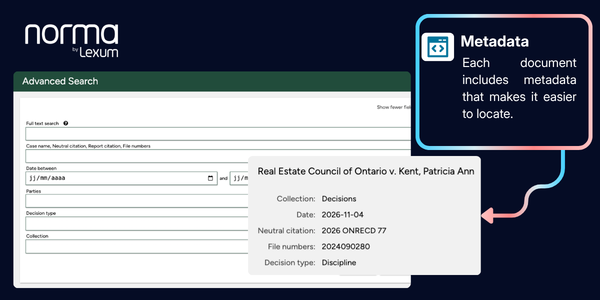
Figure 1 – Decision metadata in Norma.
These criteria can be combined with a full-text search. Solex supports keywords, exact phrases and proximity operators. The latter allow users to find terms within the same sentence or paragraph, or within a specified distance of one another. The wildcard character “*” can also replace part of a word. The engine accounts for words with the same root and different ways of writing an acronym or number. Autocomplete suggests terms as users type, while correction suggestions help refine queries containing a typo.
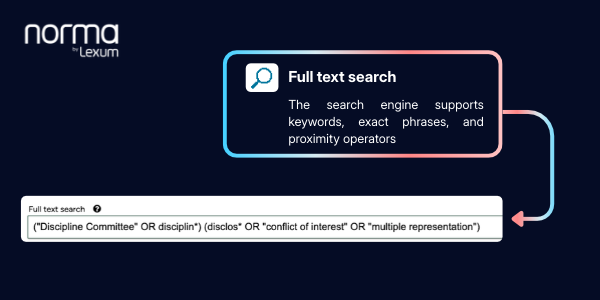
Figure 2 – A full-text search in Norma.
Excerpts in the search results provide a preview of the decisions’ content, with search keywords shown in bold. Once a document is opened, these terms are also highlighted in the text. Users can navigate between these occurrences to find the passages they want to examine.
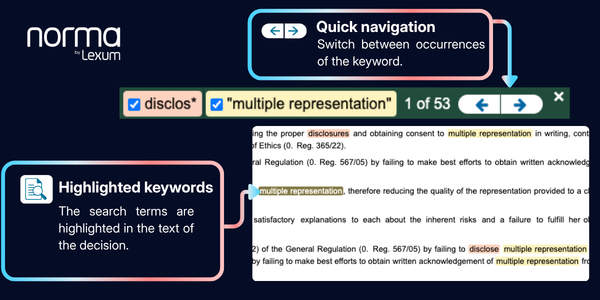
Figure 3 – Highlighted search terms and navigation.
These features are available through an interface that reflects RECO’s visual identity. The organization can therefore offer Norma’s publishing and search tools in an environment consistent with its own website.
Visit RECO’s new decisions site.
More reach through integration with CanLII
The integration with CanLII makes their decisions available in a dedicated RECO collection on CanLII. This publicly accessible database allows users to consult them and include them in searches covering publications from other regulatory bodies and courts.
With a myCanLII account, users can also benefit from CanLII Search+, the AI powered research assistant developed by Lexum. The tool turns a natural-language question into a structured search query. It can then analyze the results, explain their relevance to the question and provide links to useful paragraphs. These features help users refine their search and identify documents worth reviewing.
myCanLII features also help users organize the documents they find and stay up to date. Users can save decisions in research folders, add notes and create alerts to follow new RECO publications or changes to decisions already available on CanLII.
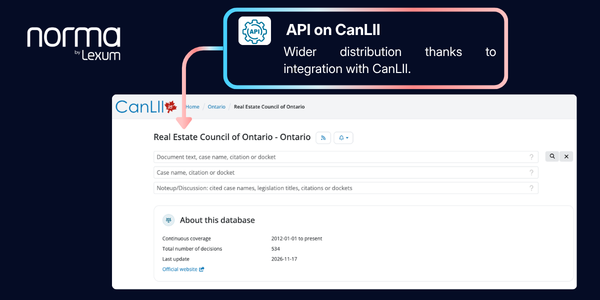
Figure 4 – RECO’s collection on CanLII
Explore RECO’s collection on canlii.org.
A tailored publishing solution for regulatory organizations
The RECO project builds on our work with organizations that publish disciplinary decisions, including the Real Estate Council of Alberta. Our team uses its editorial and technical expertise to tailor Norma to their publishing practices and their users’ needs.
Would you like to make your organization’s decisions easier to access? Discover Norma and let’s discuss your project.