


Democratizing access to legal information and documentation has become an essential component of the contemporary quest for better access to the law and, consequently, to justice. Since the 1990s, Canada has seen the emergence of several digital resources that allow users to consult provincial and federal legislation and case law, as well as legal commentary pertaining to or governing these levels of government. Among these initiatives, the Canadian Legal Information Institute (CanLII) website, developed and operated by Lexum, has become a leading and widely relied-upon resource.
As access to legal sources continues to expand, one level of government remains particularly challenging in terms of locating and accessing the legal norms it produces: municipalities. Based on this observation, the Notarial Studies Fund granted financial support to CanLII to conduct a study assessing the feasibility of improving access to primary sources of municipal law (“Study”), such as by-laws, municipal council resolutions, and orders, through the establishment of a dedicated website or “Portal.”

The Notarial Studies Fund provides financial support for collective initiatives that foster the development of a vibrant and accessible legal system for the Quebec population.
CanLII entrusted the execution of this mandate to a specialized team at Lexum.

Our Approach
To better understand the barriers to accessing primary sources of municipal law, the Study first undertakes an in-depth comparative analysis of local governance structures and their online documentation publication practices. In parallel , the Lexum team also examined a corpus of documents from various municipalities and regional authorities to classify them by type, assess their technical characteristics, and reconstruct users’ search paths.
An advisory committee composed of experts in municipal legal documentation—primarily from local municipalities and municipal associations in Quebec—supported Lexum in this initiative. Their input informed several aspects of the study, including the definition of the Portal’s objectives, the classification and selection of documents, the standardization of their formats and technical specifications, collection procedures, information organization, search functionality, and funding mechanisms.
A Difficult Access to Sources of Municipal Law
The analysis of current practices reveals a clear finding: despite the significant efforts municipalities make to publish relevant information to local communities, accessing primary sources of municipal law remains cumbersome throughout Canada. In Quebec, as in other Canadian provinces, this situation stems from a fragmented publication of document , compounded by publication practices based on heterogeneous and often suboptimal methods of organizing, searching for, and consulting information.
These challenges make it harder for notaries, lawyers, and other professionals to effectively advise their clients. They also make it more difficult for municipal administrations to learn from their peers’ practices and to improve their own document development, management, and publication processes. Finally, it reduces the ability of local residents to understand the rules that govern their daily lives.
A Necessary and Useful Portal
Not all municipalities have the same resources to invest in effective online publication technologies. Against this backdrop, there is a clear need for a portal that would provide a single point of access to primary sources of Quebec municipal law, and, eventually, those of other Canadian provinces. A unified document repository, harmonized classification, a user-friendly navigation interface, sustainable document coverage, and powerful search capabilities: this is what the Portal would offer to a wide range of users (municipal administrations, professionals, businesses, and the general public) brought together around a common repository.
A Feasible Portal
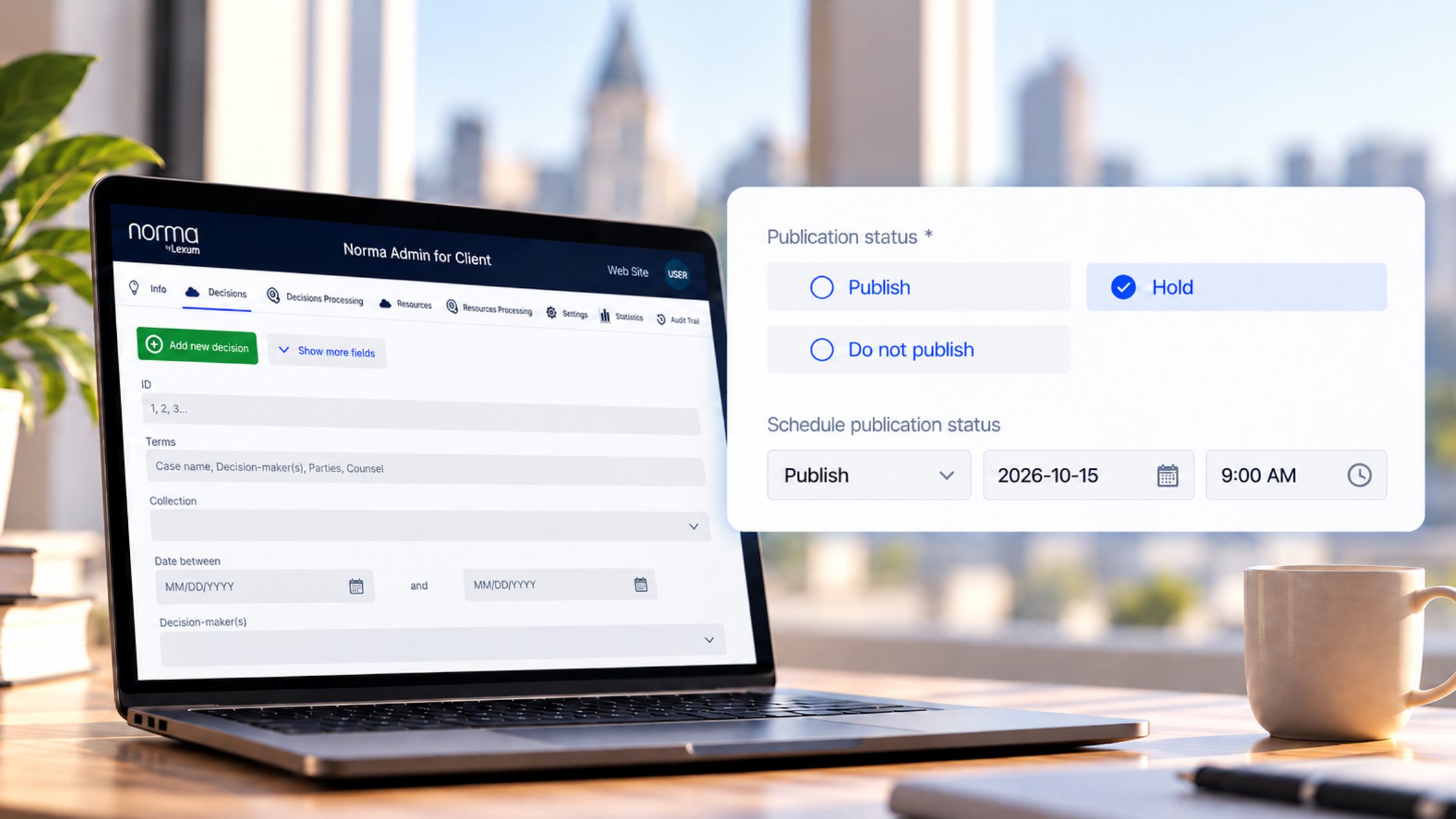
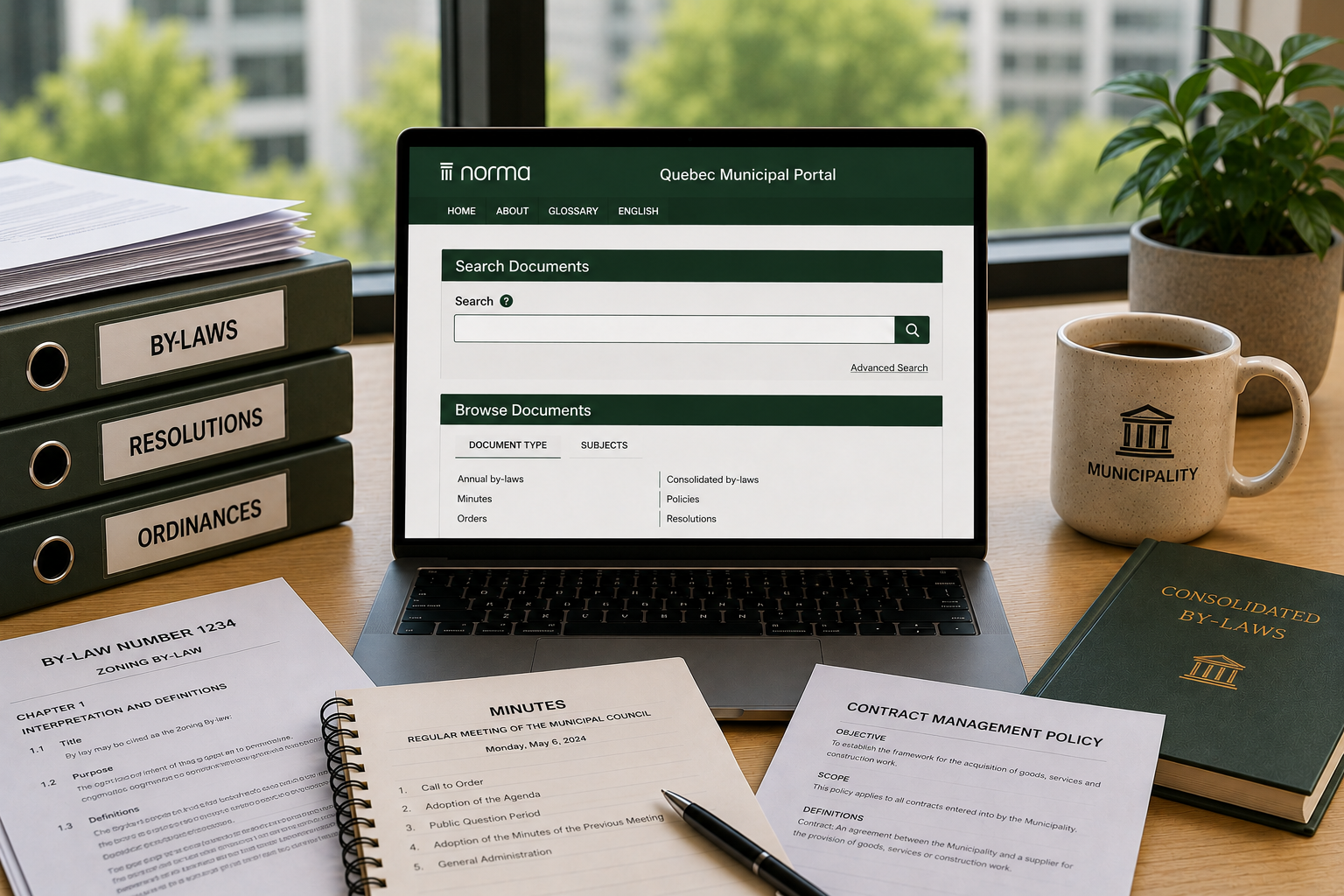
Combined with the other components of the Study, the development of a prototype titled “Quebec Municipal Portal” (“Prototype”) confirmed the practical feasibility of the Portal. Built on Lexum’s Norma solution and incorporating a sample of documents from local municipalities participating in the Advisory Committee, as well as from certain regional authorities, the Prototype showcases most of the proposed information structure and functionalities, while also helping identify the additional developments required to meet the expectations of the Portal’s intended users.
A Progressive Implementation
The Study outlines a structured development plan for the Portal, to be implemented gradually over a period of approximately three to five years: an initial operational version, followed by a gradual expansion of its features, content, and geographic coverage, leading to a mature, Canada-wide version of the Portal by the end of the first three years. A digital transition committee will support this process, notably by promoting the adoption of best practices for the preparation and dissemination of statutory instruments amongst municipalities. Finally, while maintaining the growth of the Portal’s operations, the following years will be focused on securing the funding arrangements necessary to ensure the Portal’s long-term sustainability.
A Unifying Initiative for Better Access to the Law
The Study demonstrates that a practical and realistic solution can be developed to improve access to primary sources of municipal law. Much like the role played by CanLII with respect to legislation and case law, the proposed Portal has the potential to become a lasting documentary resource that substantially improves access to law and strengthens public trust in local institutions. Achieving this goal will not only require a solid editorial and technological foundation, but also the commitment of municipalities and professionals to a sustainable funding model.
Are you interested in contributing to the portal project?
Do you represent a local municipality, a regional authority, a municipal association, a professional body, or another organization interested in contributing to the Portal project?