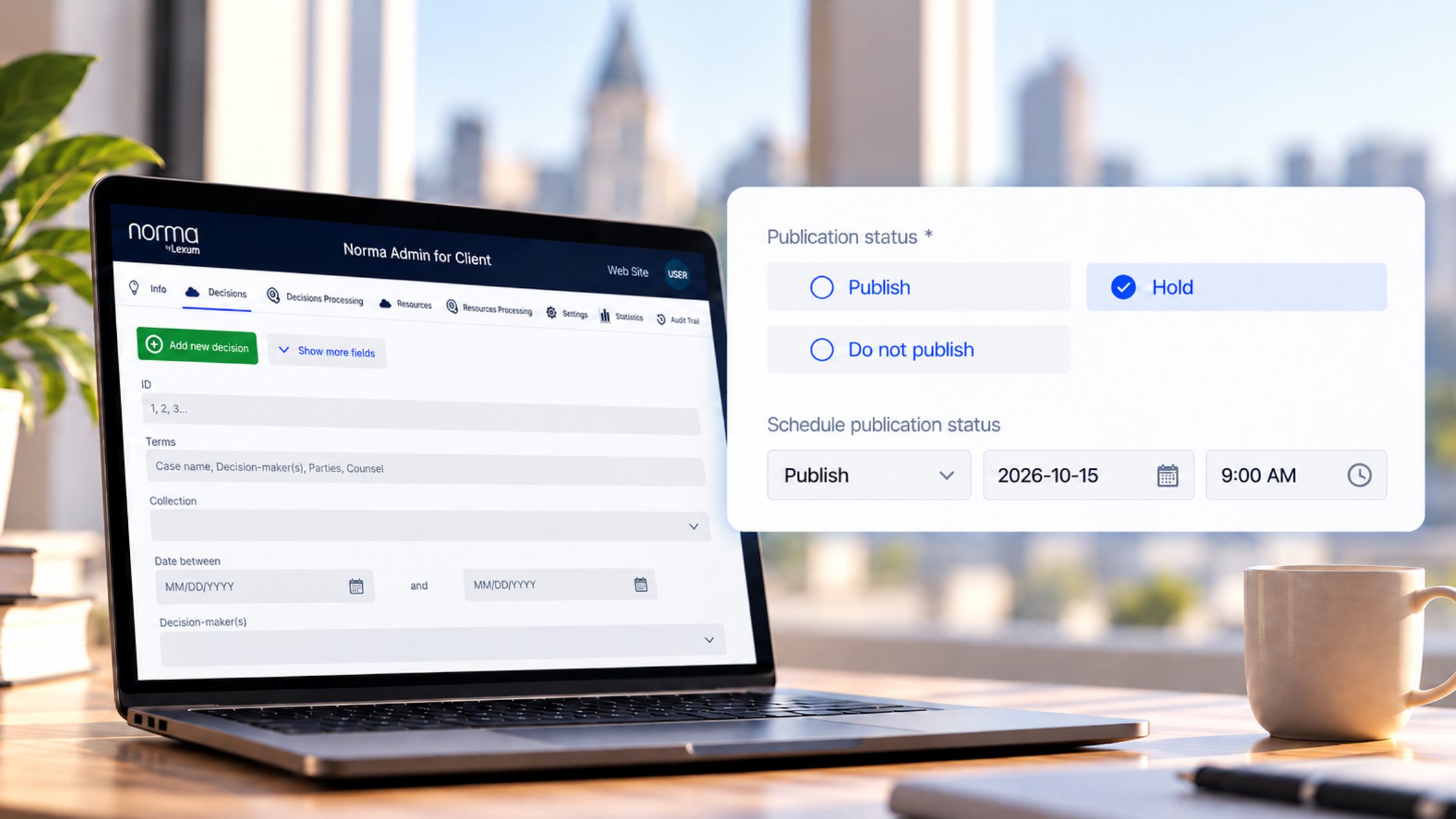




Making legal information available online and easy to digest is an important aspect of improving access to justice.
In Volume 12 of the LegalTech Diaries series published by LegalTechTalk, Pierre-Paul Lemyre, our VP Business Development, shares a clear vision of a major turning point in legal publishing. Access to justice is no longer measured by simply putting documents online, but by users’ real ability to find, understand, and use legal information effectively.
Three Key Takeaways From the Interview
1. “Meaningful access”: when legal publishing goes beyond basic access
Pierre-Paul Lemyre observes a clear shift in institutional expectations. Legal organisations are no longer looking to simply publish documents “somewhere” on the web. They are now seeking to deliver a genuine legal research experience, one that surfaces relevant results quickly and enables intelligent navigation through the law.
This shift translates into concrete requirements for technology solutions: high-performance search engines, features that reduce repetitive tasks, and citators capable of automatically detecting and linking references.
Why this matters: it marks the transition from a minimal web presence to a useful legal research environment, designed for both legal professionals and the public.
2. AI is transforming editorial work, without delegating responsibility
Pierre-Paul addresses the impact of AI on legal publishers themselves. Tasks that were once manual (document analysis, structured data extraction, and the production of value-added content) are now largely automatable.
However, this automation does not eliminate human expertise; it reshapes it. At Lexum, editors are increasingly responsible for designing, supervising, and improving automated workflows based on language models, ensuring quality, consistency, and reliability.
Human oversight remains central to the methodological framework, standards, and governance of legal information.
3. From document retrieval to analysis: a paradigm shift
Legal research is no longer only about locating cases or statutes, it’s more and more about exposing and explaining their content and relationships. Thanks to AI-enabled contextual analysis, systems can now summarise, classify, and explain legal information, significantly reducing traditional technical barriers to understanding the law.
At Lexum, this evolution is reflected in the growth of the Legal Information team, supported by dedicated expertise focused on designing and maintaining processes built on Large Language Models (LLMs) with a clear objective: ensuring quality, consistency, and accountability.
This transformation has a direct impact on access to justice. When legal information is better explained and contextualised, it becomes usable not only for legal professionals, but also for the public and non-lawyers. This represents a natural continuation of Lexum’s long-standing mission: to broaden and deepen access to the law, without ever replacing professional legal judgment.
And above all, as Pierre-Paul reminds us: legal research remains a matter of professional judgment. Tools may accelerate, explain, and guide; but final responsibility for validating findings always remains with the person involved.
“… to deliver what I would call meaningful access : access that allows users to find, understand, and contextualise legal information efficiently.”

Access the full interview in LegalTech Diaries (vol. 12)
LegalTech Diaries Volume 12
____
Lexum at LegalTechTalk 2026
Building on these reflections on the evolution of access to legal information, Lexum will be attending LegalTechTalk 2026.
📍 InterContinental London – The O2, London, United Kingdom
📅 June 17-18, 2026
Come meet our team and discuss the key themes from the interview: legal publishing, meaningful access to the law, and responsible uses of AI.
Video: LegalTechTalk announcement